Why Hutto & Taylor homes crack more than Cedar Park homes
Two houses, same county, same age — one develops stair-step cracks and sticking doors while the other never moves. The difference is almost always the dirt underneath.
Williamson County is split down the middle by geology. Drive east of I-35 — Hutto, Taylor, Pflugerville — and you’re on deep Blackland Prairie clay, some of the most expansive soil in Texas. Drive west toward Cedar Park and Leander and the ground turns to Edwards limestone along the Balcones Escarpment. Clay swells and shrinks with the seasons; rock doesn’t. That single fact explains most of the foundation-movement gap between the two sides of the county.
What “expansive clay” actually does to a slab
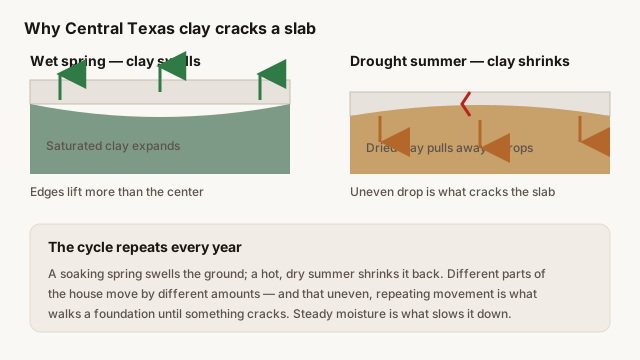
Blackland clay has a high plasticity index — the technical way of saying it holds a lot of water and changes volume dramatically when that water comes and goes. After a wet Central Texas spring, the clay swells and pushes up. Through a brutal drought summer, it dries out and shrinks away, and the ground literally drops. A slab-on-grade foundation rides that movement, and because the edges of a house dry out faster than the protected center, the movement is uneven. Uneven movement is what cracks a foundation.
This is why the damage shows up as a pattern, not a single flaw: diagonal cracks stair-stepping out of the corners of doors and windows, interior doors that jam by August and swing free by December, brick mortar separating, and gaps opening under the baseboards. None of that is a defect in how the house was built — it’s the ground doing what Blackland clay does.
Why Cedar Park and Leander move less
West-county homes over shallower Edwards limestone sit closer to stable rock. Rock doesn’t shrink and swell, so there’s far less seasonal movement to crack a slab. When those homes do need foundation work, the piers often don’t have to travel as far to reach load-bearing ground — which is why the same repair can cost less on the west side than the east. It’s not that Cedar Park builders are better; it’s that they built on better dirt.
The catch: west county isn’t uniform. Plenty of Cedar Park and Leander lots were cut and filled to make level building pads, and that fill can settle unevenly on its own. So a house on engineered fill can move even where the native ground is rock. The only way to know your specific situation is an elevation survey and an engineer’s look.
The Hutto and Taylor factor: new subdivisions aging together
East county has a second thing working against it. Hutto and Taylor have exploded with new slab subdivisions — Star Ranch, Emory Farms, and the wave of building around the Samsung fab in Taylor. When a whole subdivision goes up in the same few years on the same deep clay, those homes all hit the 15-to-25-year movement window at the same time. That’s why a single street can see several neighbors calling for foundation assessments the same season after a hard drought.
The water is the problem; the piers are just the fix
Because moisture drives clay movement, the smartest local crews look at drainage before piers. Downspouts dumping next to the slab, poor grading that pools water at the foundation, or an under-slab plumbing leak can all drive the exact movement you’re trying to correct. Sometimes the honest fix is gutters, grading, and consistent watering — not thousands of dollars of steel. A crew that quotes piers without ever asking about your drainage is one to be cautious of.
What this means if your east-county home is cracking
If you’re in Hutto, Taylor, Pflugerville, or east Round Rock and seeing the pattern — stair-step brick cracks, doors that stick seasonally, gaps at the trim — it’s worth an assessment, ideally starting with an independent structural engineer who doesn’t sell repairs. Their read on how many piers you need (if any) is neutral, and it becomes the scope every contractor bids against. There’s a full walkthrough of how the repair works and how to vet a company, and honest cost ranges so you know what a fair quote looks like.
Get a local read on your foundation
Tell us what you’re seeing and your city. We’ll match you with independent contractors who actually read east-county clay — up to three, free, no obligation.
More foundation guides: 7 foundation warning signs on WilCo clay · Watering your foundation through a Texas drought